If you have a heavily filled, cracked or weakened tooth, understanding crown vs onlay vs overlay can help you learn more about the different options your dentist may recommend to protect and restore it.
All three restorations can be used to restore and protect damaged teeth. The main differences are how much of the tooth they cover and how much natural tooth structure needs to be prepared.
What is cuspal coverage?
To understand the difference between an onlay, overlay and crown, it helps to understand cuspal coverage.
The cusps are the raised parts of your back teeth that help you chew.
When a tooth has a large filling, has lost a significant amount of tooth structure, contains cracks or has undergone root canal treatment, the remaining tooth structure may be at greater risk of fracture.
Cuspal coverage means protecting some or all of these weakened cusps with a restoration designed to distribute chewing forces and protect the remaining tooth.
Depending on the condition of the tooth, this may be achieved with an onlay, overlay or crown.
What is a dental onlay?
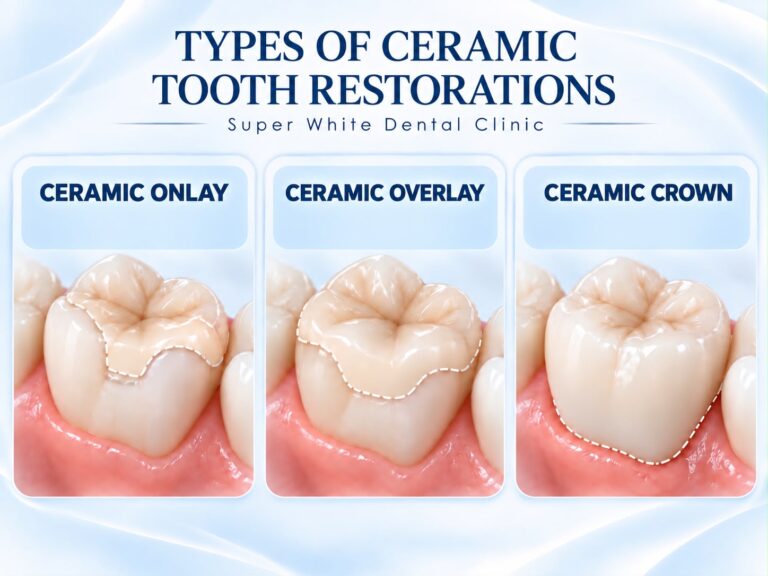
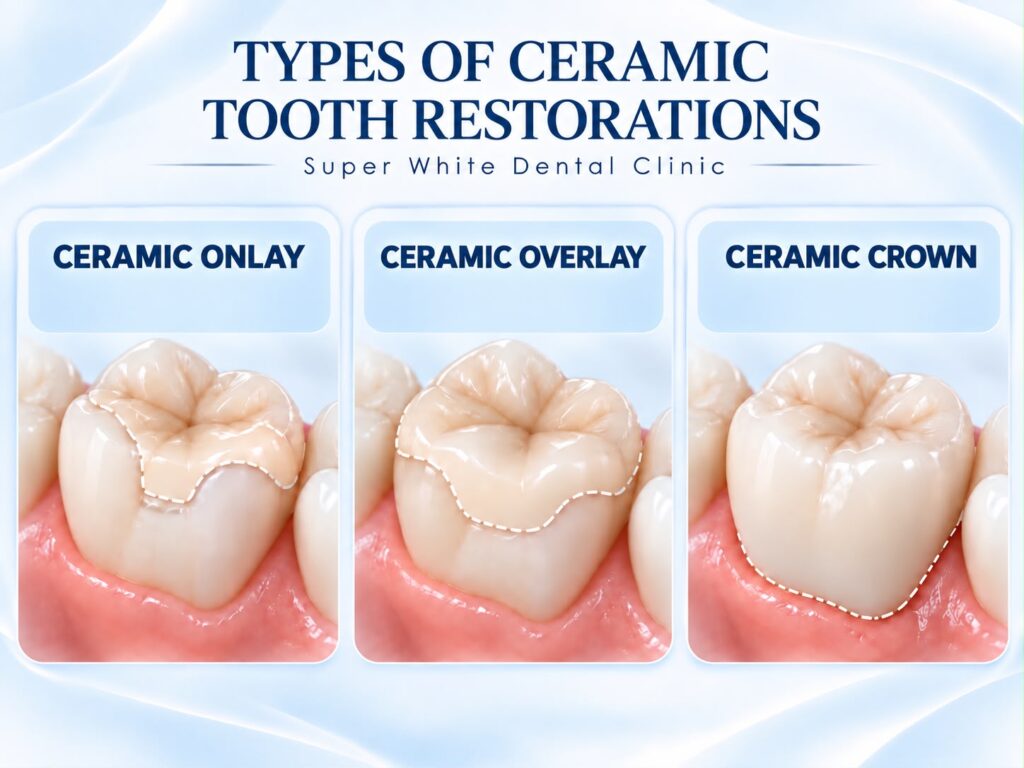
A dental onlay is a restoration that replaces part of the damaged tooth and covers one or more cusps that need additional protection.
Unlike a traditional crown, an onlay does not necessarily cover the entire tooth.
This means that when the clinical situation allows, an onlay can preserve more healthy natural tooth structure while restoring the tooth’s shape, strength and function.
Onlays are commonly made from strong restorative materials such as ceramic.
When might an onlay be recommended?
Your dentist may consider an onlay when:
• A tooth has a large or failing filling
• One or more cusps have become weakened
• Part of the tooth has fractured
• There is enough healthy tooth structure remaining to avoid a full crown
• A stronger, more protective restoration is needed than a conventional filling
The decision depends on the condition of the entire tooth, not simply the size or number of surfaces involved in an existing filling.
What is a dental overlay?
A dental overlay covers the entire chewing surface of a tooth, including all of its cusps.
It provides more extensive cuspal coverage than an onlay, while potentially preserving more natural tooth structure than a traditional full crown.
An overlay may be considered when a back tooth is more extensively weakened and all of the cusps would benefit from protection.
When might an overlay be recommended?
An overlay may be considered when:
• A tooth has a very large existing filling
• Several cusps are weakened or damaged
• Significant tooth structure has been lost
• The tooth has cracks or is at increased risk of fracture
• A root canal-treated tooth requires additional protection
Ceramic overlays can be designed to recreate the tooth’s natural shape, chewing surface and function while preserving healthy tooth structure wherever possible.
What is a dental crown?
A dental crown covers the tooth more extensively than an onlay or overlay.
It covers the chewing surface and extends around the sides of the tooth, creating a protective restoration around the remaining tooth structure.
When might a crown be recommended?
A crown may be appropriate when:
• A tooth is extensively broken down
• There is insufficient healthy tooth structure for a more conservative restoration
• The tooth contains a very large restoration
• The remaining tooth structure requires more extensive protection
• Previous restorations have failed
Crowns remain an important treatment option, but they are not automatically necessary for every heavily restored or root canal-treated tooth.
Where clinically appropriate, your dentist may consider a more conservative restoration such as an onlay or overlay.
Onlay vs Overlay vs Crown: What’s the Difference?
The simplest way to understand the difference is by looking at how much of the tooth each restoration covers.
Onlay: covers part of the chewing surface and one or more cusps.
Overlay: covers the entire chewing surface and all of the cusps.
Crown: covers the chewing surface and extends more fully around the sides of the tooth.
The most appropriate option depends on how much healthy tooth structure remains and how much protection the tooth requires.
Do I Need a Crown After Root Canal Treatment?
Not every root canal-treated tooth automatically requires the same type of restoration.
Back teeth that have undergone root canal treatment may require cuspal coverage because the amount of remaining tooth structure, previous decay and existing restorations can increase their susceptibility to fracture.
Depending on the individual tooth, this protection may be provided by an onlay, overlay or crown.
Your dentist will assess how much healthy tooth remains, whether cracks are present, the position of the tooth and the forces placed on it when you bite and chew before recommending the most appropriate restoration.
Digital Crowns, Onlays and Overlays
At our practice, crowns, onlays and overlays are created using a digital dental workflow.
Instead of taking a conventional dental impression using impression material, we use an intraoral digital scanner to create a detailed 3D image of your teeth.
At your first appointment, the tooth is carefully prepared for the planned restoration and digitally scanned.
The scan is then sent securely to our dental laboratory, where the restoration is designed and manufactured to fit your tooth.
At your next appointment, your dentist checks the fit, bite and appearance before bonding or cementing the completed restoration into place.
Digital scanning can make the impression stage more comfortable for many patients and provides the laboratory with detailed digital information from which to create the restoration.
Is an Onlay Better Than a Crown?
Neither treatment is automatically better.
Modern dentistry aims to preserve healthy natural tooth structure whenever clinically appropriate, but the restoration must also provide enough protection for the tooth.
An onlay or overlay may allow more natural tooth structure to be retained in suitable cases. A crown may provide a more appropriate solution when a tooth is extensively damaged or there is insufficient healthy structure remaining.
The best treatment is therefore the least invasive restoration that can predictably protect and restore that particular tooth.
How Does My Dentist Decide Which Restoration I Need?
Your dentist will consider several factors, including:
• How much healthy tooth structure remains
• The size and condition of existing fillings
• Which cusps are weakened or missing
• Whether cracks or fractures are present
• Whether the tooth has undergone root canal treatment
• Your bite and chewing forces
• The position of the tooth in your mouth
• The condition of the surrounding teeth and gums
There is no single restoration that is right for every tooth.
Crown, Onlay or Overlay: Which Is Right for Your Tooth?
The aim is not simply to place the largest or strongest restoration possible.
The goal is to protect the weakened tooth, restore its natural anatomy and function, and preserve as much healthy natural tooth structure as clinically appropriate.
If you have a large filling, a cracked tooth, a root canal-treated tooth or have been told that you may need a crown, book a consultation with our dental team.
We can assess the tooth, explain whether an onlay, overlay or crown may be appropriate and discuss the advantages and limitations of each option for your individual situation.
📞 +44 2036457885
💬 07947903827
✉️ info@superwhitedentalclinic.co.uk
📍 41 S Lambeth Rd, London SW8 1RH, United Kingdom